📎 mind the minutes
spend some time with time itself
https://toggl.com/time-perception-game
edit: the page no longer exists...
spend some time with time itself
https://toggl.com/time-perception-game
edit: the page no longer exists...
1. I will never allow anyone else to make me a cog. I will never do what is stupid or horrible because “that’s what the regulations say” or “that’s what my supervisor said,” and then sleep soundly at night. I’ll never do my part for a project unless I’m satisfied that the project’s broader goals are, at worst, morally neutral. There’s no one on earth who gets to say: “I just solve technical problems. Moral implications are outside my scope.”
https://www.scottaaronson.com/blog/?p=4292
(and the referenced article about Hannah Fry’s call)
You’ve seen the stories—in the Financial Times, Technology Review, CNET, Facebook, Reddit, Twitter, or elsewhere—saying that a group at Google has now achieved quantum computational supremacy with a 53-qubit superconducting device. While these stories are easy to find, I’m not going to link to them here, for the simple reason that none of them were supposed to exist yet.
So now we can say with certainty that the most metal bird is the raven:
https://jgeekstudies.org/2019/09/01/bird-biodiversity-in-heavy-metal-songs/
Personal websites are called personal websites because they are just that: personal. Thus, the primary objective still is to have a place to express ourselves, to explore ourselves, a place that lasts while the daily storms pass by. A place of consideration, and yes, a place of proudly sharing what we do, what we think, and what we care about. A place to contribute your voice and help others. A home on the internet. A place to tell your story.
But on top of that, we have the chance to (re-)establish personal websites also as central elements of online discourse and as entry points for people who are new to the web community. For this, we need to find ways to create an ecosystem that lives up to the diversity of the personal-website-verse. Consequently, what will hold our sites together, is most possibly not one technology to rule them all, but a multitude of different and ever-evolving technologies. Things like hyperlinks, comments, Webmentions, and RSS, of course, but also other technologies that have yet to be invented. Not only would this leave enough room for individual preferences, but it would also make the whole construct more resilient while still being flexible enough to evolve over time.
https://matthiasott.com/articles/into-the-personal-website-verse
This is a list of free software network services and web applications which can be hosted locally. Self-hosting is the process of locally hosting and managing applications instead of renting from SaaS providers.
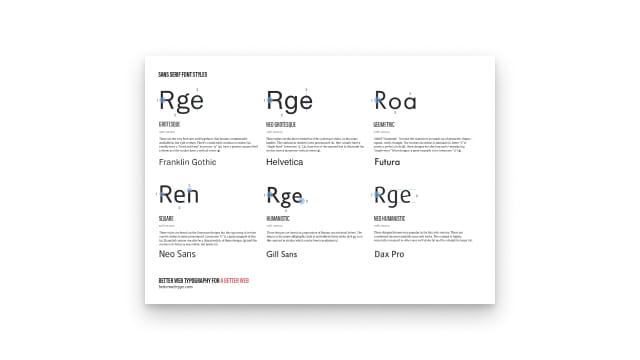
https://betterwebtype.com/assets/pdf/better-web-type-font-styles-cheat-sheet.pdf
Source: Better Web Type
I’m at the department, drinking coffee in the common room while browsing the web. All of a sudden my auditory sensors detect the phrase: “this could be a very strong paper”... The word combination drags my attention and curiosity—so I continue to listen:
https://transistorized.net/post/stdal/post81.htm
(wise little rant about paper-driven research)
This is an online edition of the classic technical reference Five Hundred and Seven Mechanical Movements by Henry T. Brown.
This site contains the original illustrations and text from the 21st edition of the book, published in 1908. It also includes animated versions of the illustrations, and occasional notes by the webmaster.
Bloggers thought that they were oiling the hinge of a turning point in human history. No one could have foreseen that in a couple of years this cosm of private sites would implode into five commercial black holes and turn the Web into the opposite of what it promised to be.
In a bit more than ten years, open became closed, blog became PR, hoodie became suit and Ping Pong turned into golf. That’s how revolutions work. Revolutions tend to lead back to where they started.